- CollabWORK Hiring Insights
- Posts
- What 100 marketers in a snowstorm taught me about hiring
What 100 marketers in a snowstorm taught me about hiring
I spent the day at Morning Brew's marketing summit. Here's what JBL, Tapestry, and JPMorgan figured out that most TA teams haven't.

CollabWORK
February 25, 2026

Hi everyone,
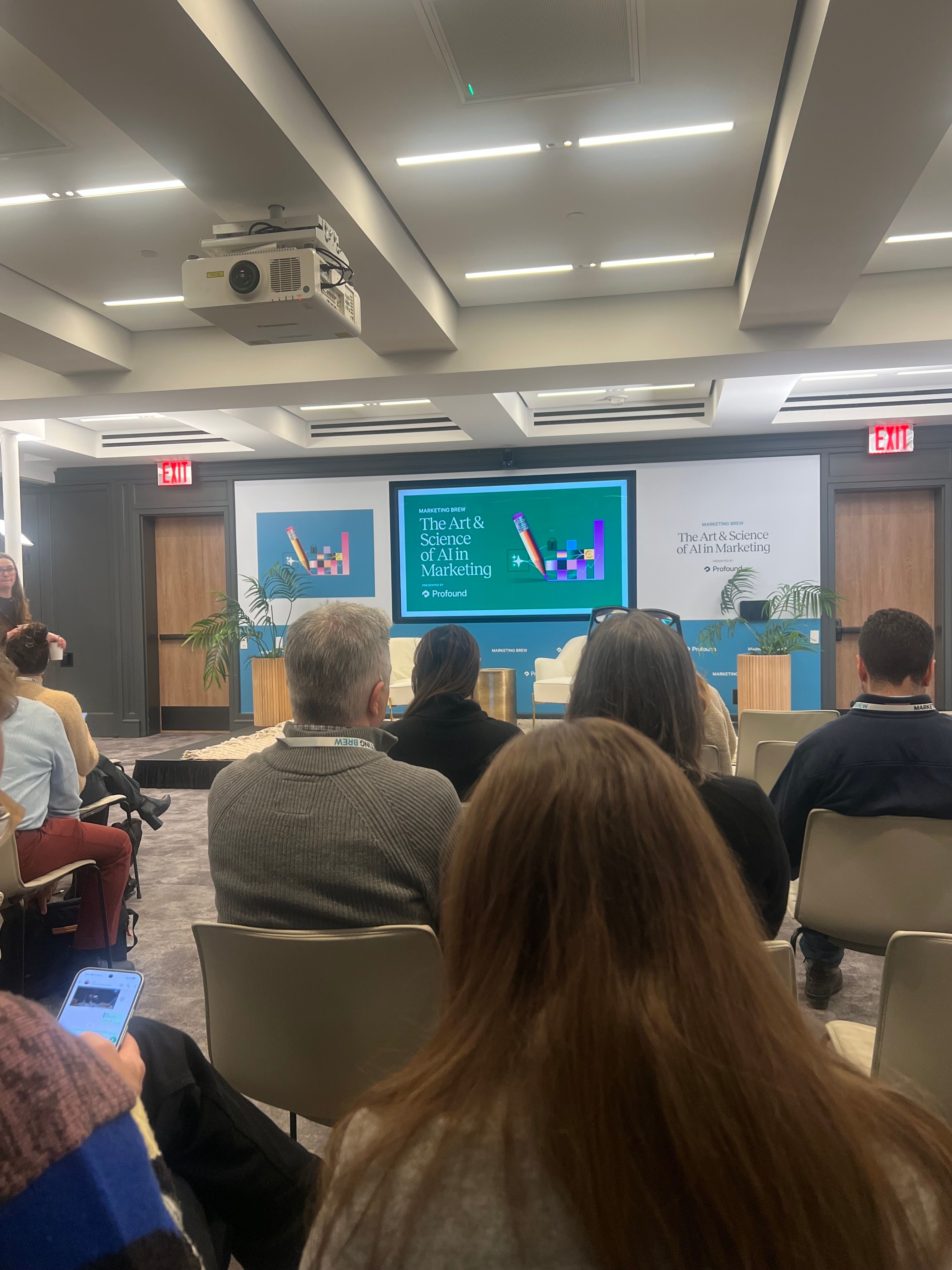
I braved the New York City snowstorm this morning to head to 30 Rock for our partners at Morning Brew’s summit, The Art & Science of AI in Marketing. There were a hundred marketers in one room, all working through the same question: how AI is changing the way people discover and evaluate brands.
Not hiring brands. Consumer brands. Nike, JBL, Tapestry, JPMorgan Chase. They're further ahead on this than most talent acquisition teams I talk to.
A few things stuck with me.
Your brand is now a dialogue, not a broadcast
David DiCamillo, CTO of Code and Theory, put it plainly: the era of controlling your brand message is over. For 20-plus years, marketing has been a monologue. You buy the media, craft the message, push it out, and monitor the comments. Even in social media, brands could steer the narrative.
AI changed that.
His point wasn't about chatbots or automation. It was that AI is now synthesizing everything about your brand — annual reports, product reviews, Reddit threads, employee reviews, factory conditions, etc. — and delivering that synthesis before anyone ever clicks your site.
The brand no longer controls what people see first. The machine does.
He called AI an "emotional product." Not because it has emotions, but because it's shaping how people feel about brands before they ever interact directly.
What JBL did about it
DiCamillo's agency works with JBL, and he walked through how they completely flipped their content strategy. Instead of pushing brand messaging out, they started listening to what people were actually asking AI. Real questions like "which headphones are best for a small apartment?" and "is a soundbar actually worth it?"
They rebuilt their content around those conversations. Not what JBL wanted to say. What people were actually asking.
According to Marketing Brew's reporting, JBL's optimized videos hit an engagement rate 200x higher than their 30-day average. And LLM referrals to their site were up over 2,400% during Black Friday weekend.
That's not a content strategy tweak. That's a fundamentally different way of thinking about discovery.
Swap "JBL" for any employer brand and the problem is the same.
Your career site says "innovative culture" and "great benefits." But when a candidate asks ChatGPT "what's it really like to work at [company]?" it's not pulling from just your careers page. It's pulling from Glassdoor, Reddit, LinkedIn posts, news articles, employee reviews. And it's summarizing that into a single answer before anyone ever visits your site.
Mandeep Bhatia from Tapestry shared that for Gen Z, the number one source for brand discovery is TikTok. Number two is ChatGPT. Google is third.
The marketers in the room weren't debating whether this shift was real. They were already operationalizing it: building content strategies, running AI visibility audits, tracking citation sources.
This connects directly to what I've been writing about in recent weeks: owned content, newsletters, and fresh material on your career site that gives AI something real to pull from. That matters, but so does knowing what AI is actually saying about you right now and what sources it's pulling from when candidates ask. Both pieces have to work together: you need to be creating content that feeds the machine, and you need visibility into what the machine is doing with it.
That's what we built CollabWORK's Employer AI Discoverability tool to do. It tracks how you appear across ChatGPT, Gemini, and Perplexity with competitive benchmarking so you can see where you're showing up, where you're not, and what's driving the gap. If last week's newsletter got you thinking about building owned content, this is how you measure whether it's working.
Reply to this email and I'll walk you through what we're seeing. More next week.
Best,
Summer Delaney
CollabWORK Founder and CEO
Further Reading
Engagement Is Distribution Strategy. Recruiters Take Note. — Bryan Chaney makes a distinction most recruiting teams are getting wrong: you're not in the content business, you're in the distribution business. And on LinkedIn, comments drive distribution — not impressions, not follower count. He has 243,000 followers and if he still needs comments to unlock reach, your company page absolutely does. Practical stuff in here on posting prompts instead of job announcements and why boosting flat content just scales mediocrity.
Wanted: Graduating AI Savant — Jim VandeHei and Mike Allen at Axios are hiring one graduating senior to embed directly with founders as an in-house AI guide and builder for the summer. The job listing says it plainly: "This is not a traditional internship. You won't be shadowing someone. You'll be the person we're learning from." Worth thinking about what the equivalent role looks like inside a TA or employer brand function.
Build Your Personal IP Toolkit — Howard Pyle from XF gave the most unexpected talk of the summit. His message to a room full of marketers: stop worrying about learning every AI tool. Start with your tacit knowledge — the stuff you know from experience that doesn't fit on a resume — and build your personal toolkit around that. He built a free tool that walks you through it. Ten minutes well spent for anyone thinking about future-proofing their own career.