- CollabWORK Hiring Insights
- Posts
- "Employer Blanding" is an AI visibility problem
"Employer Blanding" is an AI visibility problem
If AI has nothing specific to surface about you, candidates fill in the gaps themselves.

CollabWORK
March 25, 2026

Last week I got to catch up with Bryan Chaney about the newly launched People Brand Collective. He introduced a new phrase I hadn’t heard before: Employer Blanding.
Most companies don’t build a distinctive or bold employer brand. They use generic language on their corporate career pages like “we're collaborative," or "we invest in our people,” or the classic "we move fast and break things."
You've read it a thousand times. So have candidates, and now so has AI.
The brand with nothing specific to say is invisible in AI search
The same instinct that produces bland employer brand content is the same instinct that makes you invisible in AI search.
LLMs don't synthesize your mission statement. They synthesize what the internet actually says about you from third-party sources, community conversations, earned media, and yes, Reddit threads and LinkedIn articles from years ago that happen to be specific and credible. When a candidate asks "what's it like to work at [company]," the answer they get is built from whatever the open web has decided to say about you.
If you've spent years producing content that sounds like everyone else, that's exactly what AI has to work with. LLMs have nothing distinctive, nothing citable and nothing that makes a candidate think "that's the place for me."
Bravery in employer brand isn't a nice to have right now
The companies getting this right are the ones willing to say something real.
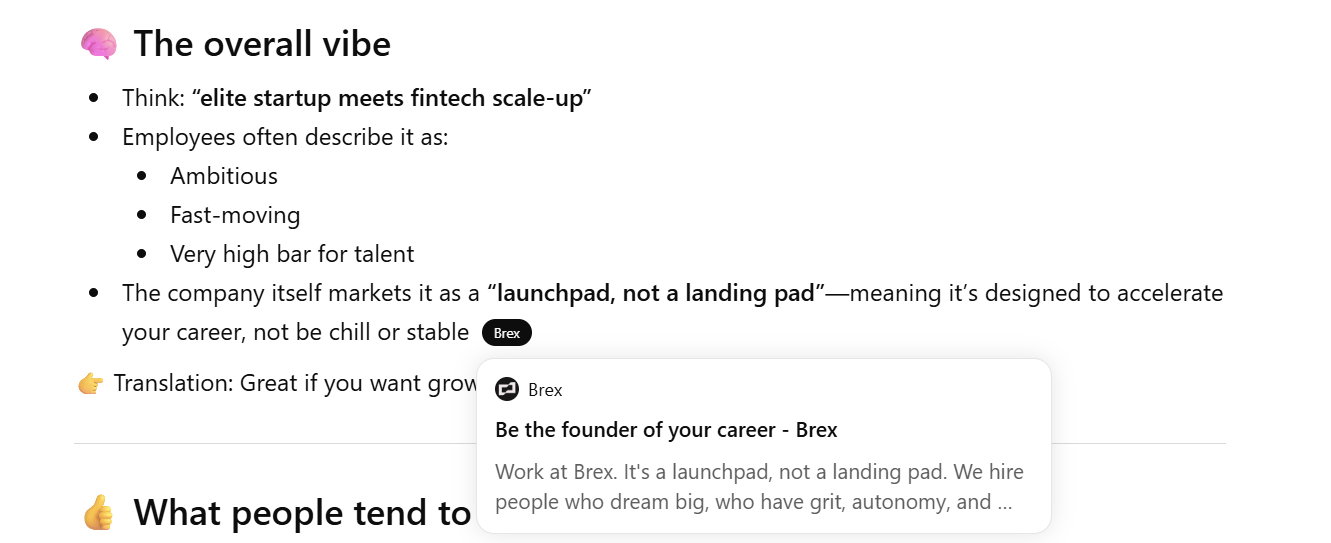
I loved Brex’s new EVP they launched in the fall: “be the founder of your career.” Brex’s CEO on LinkedIn said that over 100 alumni have started companies. He was celebrating people leaving! And it worked, because it was specific, it was honest, and it told a candidate exactly what kind of environment they'd be walking into.
That's the kind of content AI can actually work with. It has a point of view. It's attributable. It says something that isn't true of every other employer in your space.
The brands playing it safe, running everything through legal and comms until it's inoffensive and indistinguishable, are the ones that AI has the least to say about. And increasingly, if AI has nothing to say about you, candidates are forming their picture of you from whatever's left.
Oh and BTW - I asked ChatGPT and Perplexity what is was like to work at Brex. Here’s the proof how differentiation gets picked up.

The question I keep getting: how do you measure this?
This came up in a conversation with agency leaders this week. What's actually working is a layered stack. Visibility across the prompts your candidates are asking. Traffic patterns including brand and direct search lift. Self-reported attribution from candidates who found you through AI. None of these tell the whole story alone, but together they start to.
And the metric that cuts through executive conversations fastest isn't a visibility score. It's competitive benchmarking. How are you showing up relative to your talent competitors in these searches? That question everyone understands immediately.
One more thing worth getting right before you start: stop thinking in individual prompts. Candidates researching you are asking dozens of variations of the same underlying question. "Best companies to work for in [city]." "What is it like to work at [company]." And “[Company] vs [competitor]." These all ladder to the same thing.
Build presence across the whole topic cluster. Not one search. Think index fund, not individual stock. That coverage compounds over time.
We're building a working group on this
Last week I asked if anyone wanted to compare notes on AI discoverability in a small, curated group. The response was significant so we're moving forward.
If you want in, fill out the form here and we'll be in touch. Anyone who joins gets a free CollabWORK AI Employer Discoverability audit to start: https://app.youform.com/forms/jugmduzb
And if you have a take on any of this, reply to this email. More next week.
Best,
Summer Delaney
CollabWORK Founder and CEO
Further Reading
Before They Apply, Candidates Ask AI: How to Shape Your Employer Brand and Job Visibility. I'm speaking on a free HR.com webinar next Tuesday, March 31st on exactly what this newsletter covers. I’ll be diving deeper on the latest research and what you can actually do about it. Register if you want to join live.
What Young Workers Are Doing to AI-Proof Themselves. Nearly 60% of Americans between 18 and 29 see AI as a threat to their job prospects. Stanford research found employment in AI-exposed roles for workers 22 to 25 declined 16% between late 2022 and September 2025. Young workers are pivoting to trades and emergency services. If your employer brand is still pitched at an audience that's increasingly opting out of that career path, that's worth thinking through now.
What Semrush Found in 300K+ URLs Cited by AI. The most practical breakdown I've seen on what makes content get cited by LLMs versus ignored. Question-based headings showed a 22.91% higher citation rate. Q&A formatting correlated with citations at 25.45%. Strong author credentials correlated at 30.64%. The pattern is consistent: content that's easy to extract, easy to verify, and easy to summarize gets cited. Everything else gets skipped.