- CollabWORK Hiring Insights
- Posts
- A Zapier recruiter thinks 70% of their applicants are fake
A Zapier recruiter thinks 70% of their applicants are fake
The fraud problem is also a distribution problem

CollabWORK
April 16, 2026

Hi everyone,
Hello from Indianapolis. I’ve been at DEAMcon26, DirectEmployers’ annual conference, for the past two days, which is why this newsletter is a little late this week. We’ve had a great partnership with the association since last fall, distributing member jobs across our community and newsletter network.
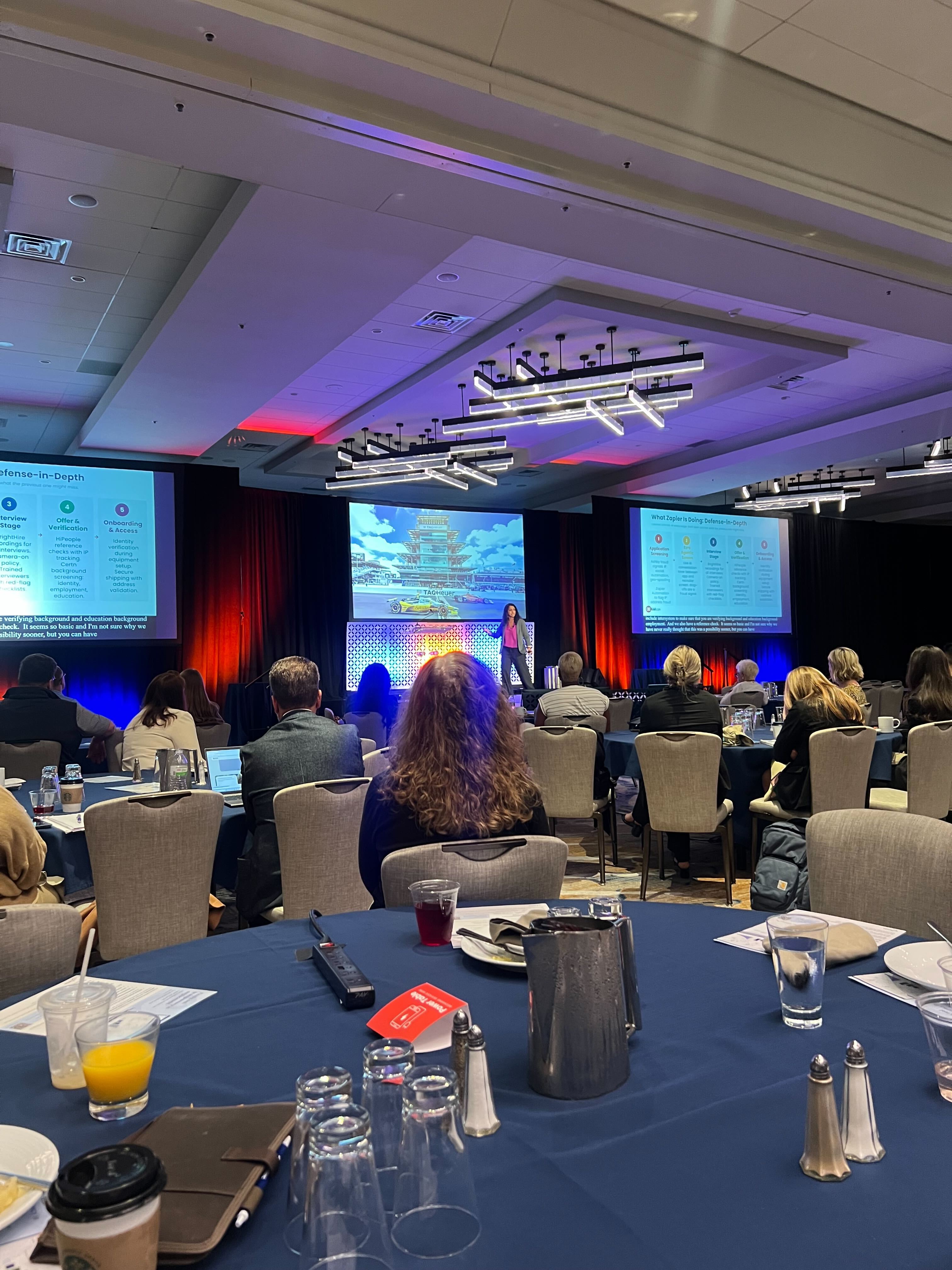
This morning, Anita Chandrasekhar, Global Head of Talent Strategy and Operations at Zapier, walked through how her fully remote team is fighting AI-enhanced candidate fraud. Real cases, real systems, and some numbers that should make every TA leader pay attention.
The numbers are worse than you think
Gartner predicts that by 2028, 1 in 4 candidate profiles worldwide will be fake. In their survey of 3,000 job seekers, 6% admitted to interview fraud, either by impersonating someone else or having someone stand in for them. And 62% of hiring professionals say candidates are now better at faking than we are at catching them.
At Zapier, roughly 25-30% of applicants for tech roles showed fraud signals last year. One of their software engineering recruiters now estimates that number is closer to 70%.
This isn’t resume padding. We’re talking deepfakes on video interviews, entirely different people showing up for the job than who interviewed, state-sponsored organized crime infiltrating companies through remote roles, and the FBI raiding 21 laptop farms across 14 states last year, seizing 137 laptops tied to North Korean IT worker schemes.
What Zapier built to fight it
Anita’s team built a five-layer defense system. Their ATS (Ashby) now flags geographic mismatches, email fraud signals, and IP address anomalies. They added an AI agent screen between application and recruiter review that asks 15 minutes of structured follow-up questions. They require cameras on for all interviews and take verification screenshots. They run live reference checks, not just written ones. And they built a Zapier automation that cross-checks the IP address of where someone submitted their application against their stated location.
She also published an acceptable AI use framework on Zapier’s careers site that tells candidates upfront: here’s how we use AI, here’s how you can use it, here’s where we draw the line.
One stat from her own hiring stood out. She opened a role and got 500 applications in a week. After pushing candidates through the AI agent screen, only about 90 completed it. A huge chunk of those were likely bot applications or candidates who used a mass-apply tool and just weren’t interested in the opportunity. Either way, it’s a signal of how much noise is flooding your pipeline before a recruiter ever sees a resume.
This is where distribution and sourcing strategy come in
The mass-apply AI tools flooding inboxes with bot applications target the easy channels (job boards, open postings). Anywhere a bot can submit with one click.
They don’t show up in a private Slack community like Old Girls Club for senior women in tech, or Serial Marketers, or Healthcare Homies. They don’t come through a Morning Brew newsletter placement in IT Brew, Healthcare Brew, or Retail Brew. When your job lives inside a trusted community or a curated newsletter, the candidates who find it are real people in real professional networks. That’s built-in fraud protection that no screening tool can replicate.
And there’s another reason we’re seeing growing interest in CRM and ATS reactivation. Candidates who applied a year or more ago, before these mass-apply tools hit the market, opted in with a real identity, went through a real process, and built a real relationship with your brand. You already know they’re legitimate. The opportunity isn’t just re-engagement. It’s trust you’ve already earned.
This is what we’re building at CollabWORK. Distributing your roles through 500+ professional communities and trusted newsletters where bad actors can’t reach. Monitoring how your employer brand shows up in AI search so real candidates find you first. And helping you reactivate the talent already in your system through content that actually gets opened.
If that’s a conversation worth having, reply to this email or reach out at [email protected].
Best,
Summer Delaney
CollabWORK Founder and CEO
Further Reading
LinkedIn’s Algorithm Killed Company Pages. Employees Are the Distribution Now. — LinkedIn’s own data shows that roughly 3% of employees share content about their company, and those shares generate approximately 30% of a brand’s total engagement on the platform. With LinkedIn’s new 360Brew algorithm rewarding expertise and authenticity over corporate broadcasting, employee voices on personal profiles are the only mechanism reaching hidden decision-makers at scale. If that’s true for marketing, it’s true for employer brand too.
How Brand Perceptions Are Actually Formed ( via Joel Cheesman) — FTI Consulting data broken out by generation shows that friends and family recommendations, word of mouth, and Google search still dominate how people form brand perceptions across every age group. Brand websites, emails, and ads hold steady too. AI search tools are beginning to register, and the takeaway for employer brand isn’t that AI doesn’t matter. It’s that the channels feeding AI (news, community conversations, employee voices) are what actually build perception. The companies showing up in AI search are the ones already winning in the channels above it.
LinkedIn Grad’s Guide 2026 — LinkedIn’s annual report on the fastest-growing industries for new grads lists Technology, Real Estate, Financial Services, Utilities, and Construction as the top five. Interesting that there is no mention of new grads pursuing careers in healthcare, despite it being the fastest-growing sector in the U.S. by employment and the largest driver of new job creation. That gap says a lot about how disconnected early talent pipelines are from where demand actually exists.